An Autonomous National Institute, Government of India, Department of Biotechnology, Ministry of Science & Technology
Home - RGCB | Academics | Ph.D. Program
RGCB - Ph.D. Program PhD Program Details 2013 July


Why a Ph.D. from RGCB?

RGCB prepares individuals who have a deep and genuine interest in discovery science to shape the translation of biotechnology through academic research towards applications for a knowledge economy, business development and science of tomorrow. Previous RGCB PhD's have all done impressive work and received excellent placements ( see list of PhDs passed out from RGCB ). Guided by an expert faculty and a host of innovative academic programs, the RGCB PhD program is made even richer by its place in Thiruvananthapuram, capital of "Gods own country".


Admission Procedure

External Candidates with Fellowships

Applications are invited twice a year (normally in November and June) and advertised in selected national newspapers and on the RGCB website. Vacancies that are available in different laboratories and interdisciplinary programs will be put up on the website.


Minimum Eligibility for Candidates

  1. Post graduation in Life Sciences, Chemical Sciences, Bioinformatics, Biotechnology, Agriculture, Veterinary Sciences and medicine graduates.
  2. Applicants must have a consistently First class academic track record (no less than 60% aggregates) and a valid research fellowship from UGC, CSIR, ICMR and DBT or eligibility to apply for INSPIRE. Candidates with other fellowships are advised to contact the Dean to confirm eligibility.
  3. Candidates awaiting final exam results can also apply. However only those candidates with a valid pass certificate will be allowed to appear for the selection interview.
  4. Candidates without valid fellowships need not apply.

Selection Procedure

  1. Students who meet the eligibility criteria will be invited to RGCB for a personal interview and faculty interaction. The total time for interview and discussion will last for a period of five days for candidates who are shortlisted. No TA or DA will be paid for attending the interview or discussions with faculty. There will be a personal interview first by a committee where the candidates will be evaluated in their subject of specialization, knowledge of research methodology, instrumentation and laboratory calculations, overall knowledge in applications of biotechnology, general research aptitude and ability to comprehend & solve research questions as well as presentation & communication skills.
  2. Each selection committee member will make his or her own evaluation. The average of all such evaluation sheets will be consolidated and a shortlist will be prepared. Only those candidates who meet a minimum criteria will be shortlisted. The names of the shortlisted candidates will be informed on the second day of the interview. All shortlisted candidates will have to stay in Trivandrum for a further period of 4 days to interact with the faculty.
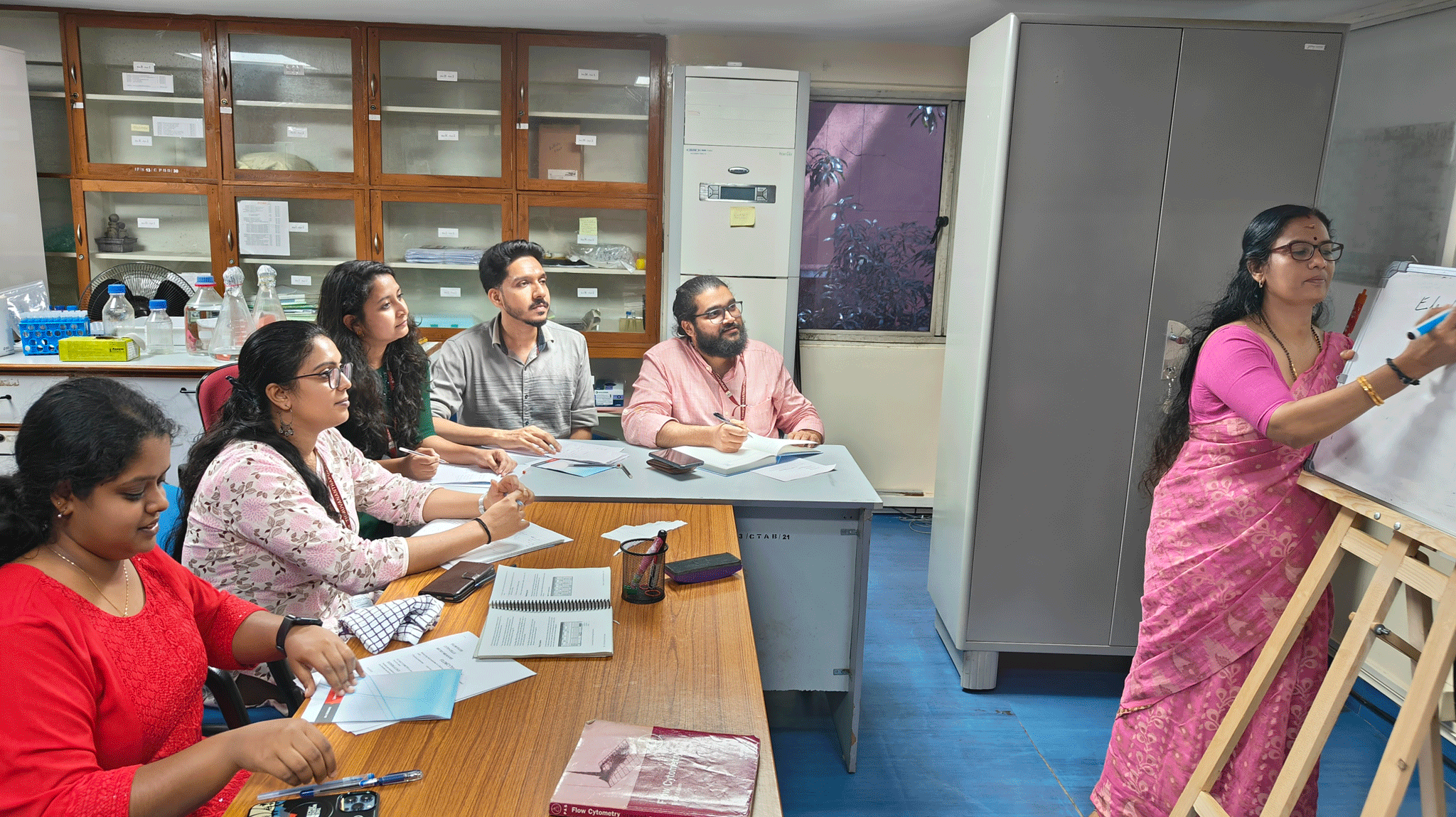
  3. During the next fourdays the students will hold personal discussions with the faculty. This would start with a group interaction where each faculty member, who have vacancies for PhD students, will talk to the students on their research interests and what they are looking for in a student. The students can then opt to have further personal one-to-one discussions with the faculty of their choice. They are encouraged to opt for as many members of the faculty as possible for these discussions to increase their chance of getting a placement. At the end of these discussions only those students, who find a perfect match with the faculty by mutual consent, will be declared as selected and will be given admission for the PhD programme. To finalise the selection, both the faculty and student have to sign a selection form. Once this selection has been made and documented, neither the student nor the faculty would be permitted to change their option.

Orientation Courses and Training Schedules

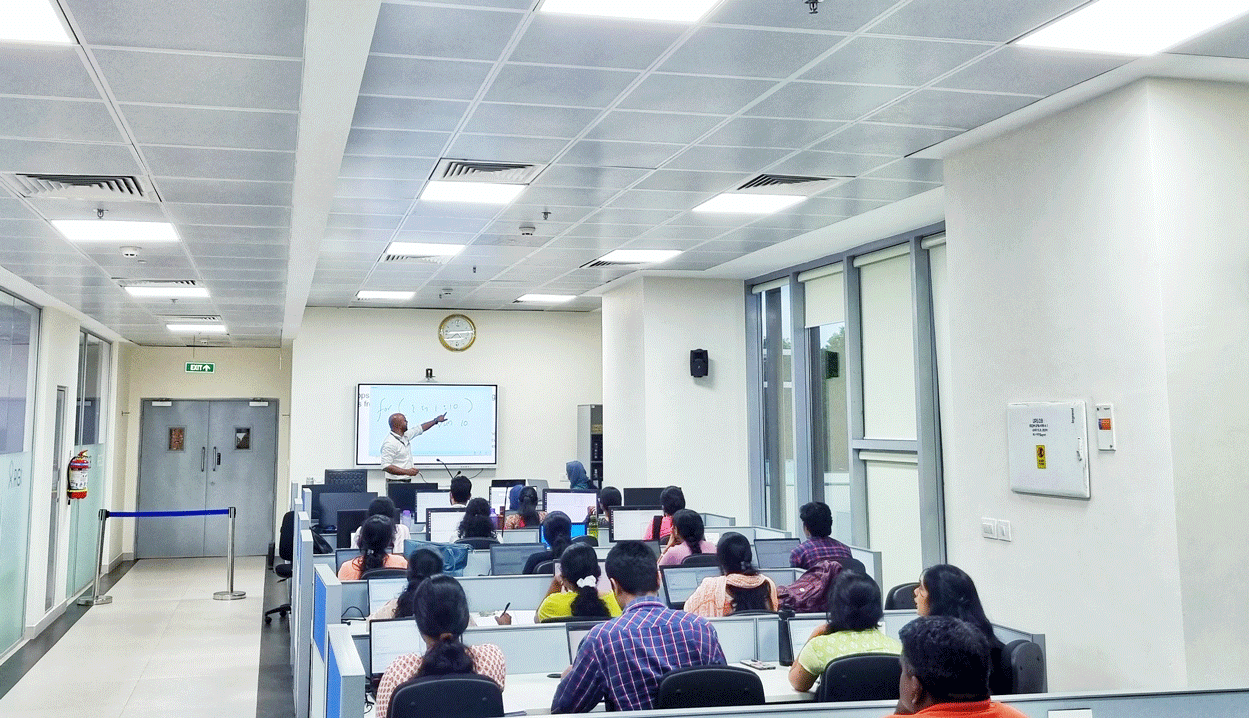
  1. All students selected for the RGCB PhD program will have to undergo a mandatory orientation and training program lasting for 2 months. This will include courses and training in Good Laboratory Practices (GLP), Radiation and Biological safety, current developments in Molecular Medicine and Disease Biology as well as Plant Biotechnology. The training schedule will also include sessions in theory and handling of laboratory instrumentation.
  2. Candidates will be assessed at the end of the orientation courses and certificates issued to successful candidates. Only those candidates who pass the coursework will be permitted to apply for PhD registration. Those students who do not pass the course work will have to appear again till they successfully clear the examination.

Guidelines for the PhD registration and research

a. RGCB Guidelines
  1. Students who successfully pass the course work and obtain the certificates will only be eligible for activation of research fellowships and PhD registration currently with the University of Kerala ((www.keralauniversity.ac.in)
  2. Students are expected to submit the thesis before completion of the fellowship tenure. The maximum period of studentship at RGCB will not exceed five years from the date of registration.
  3. Students not completing their PhD within the stipulated period will also lose the right to continue staying in institute accommodation.
  4. The students need to have peer reviewed publications as first author with a total impact factor not less than 3
  5. The work of the student is subject to periodic review .
b. Guidelines of Kerala University
  1. The student will have to present a PhD dissertation proposal to the Kerala University doctoral committee when called for by the University
  2. University of Kerala has initiated mandatory coursework along UGC norms and all students will have to qualify the exams.
  3. The students will also have to comply with any rules or modifications that the University of Kerala will bring about from time to time
    (www.keralauniversity.ac.in)

Internal Candidates working in Projects

  1. Research Fellows working in an externally funded project in RGCB are eligible to apply.
  2. A supervisor can guide only two such project PhD students at any given time. The total number of PhD candidates (including the project PhD recruits) for any supervisor at any given time will not be permitted to exceed six.
  3. Candidates should have the eligibility for PhD registration with the University of Kerala at the time of application for PhD recruitment.
  4. The project in which the candidate is working at the time of applying for PhD should have at least 18 months more of funding.
  5. The Research Fellow will be permitted only to register with the same scientist with whom he /she is associated as a project fellow.
  6. The candidate will receive financial assistance from the project till it ends. RGCB will NOT provide any financial assistance to the candidate for completion of the PhD. It is expected that the candidate will eventually find his/her own fellowships (such as Senior Research Fellowships from a National funding agency) to support him/herself for completion of the PhD.
  7. Applications will be considered twice in a year along with the recruitment of Direct PhD candidates. A notification to this effect will be displayed in RGCB notice-boards in advance. Application form for the Project PhD recruitment can be downloaded from the RGCB website.
  8. RGCB Selection Committee will not conduct any selection interview for PhD recruitment of project fellows The supervisors are required to constitute a selection committee, comprising the supervisor as Chairman and two other RGCB scientists as members. The committee will be ratified by the Director. This committee shall evaluate the candidate/s following an interview and/or work presentation and then provide a recommendation letter for permitting the PhD registration. It is mandatory that the applications of the candidates are submitted along with this recommendation letter.
  9. All such PhD recruits will undergo a compulsory course work (but no laboratory rotations) along with the Direct PhD recruits. It is mandatory for the candidates to qualify the course work for being eligible for PhD registration with Kerala University.
  10. All these PhD recruits will be provided hostel accommodation, subject to availability, like direct PhD recruits.
  11. Other existing requirements/guidelines for completion of the PhD programme including the total duration of the research programme, requirement for publications and duration of hostel stay are applicable equally to project-mode and Direct PhD recruits.
 

Ph D THESES

Sl No Title Year Name of Student Name of Research Guide
1Functional role for the Goat Uterine Nuclear Estrogen Receptor in Post-Transcriptional control mechanisms2000Thomas SebastianDr. R V Thampan
2Molecular mechanisms associated with the Plasma Membrane - To - Neucleus Movement of the Goat Uterine Non- Activated Estrogen Receptor2000Sreeja, S Dr. R V Thampan
3Hepatitis C Viruses (HCV): Studies on Viral Genotypes and its Role in HepatoCellular Carcinoma 2001 Chetan Datta Poduri Dr. M R Das
4 Molecular signatures of Tribal Populations in Kerala based on DNA Finger printing 2002 Anitha, A Dr. Moinak Banerjee
5 Endoplasmic Reticulam-To-Nucleus movement of the Goat Uterine Estrogen Receptor Activation Factors: Identification of the key Proteins involved 2002 Anitha P Govind Dr. R V Thampan
6 Molecular Alterations of SMAD 2 and SMAD 4 in Human Cervical cancer 2002 Tessy Thomas Maliekal Dr. Karunagaran
7 IS6110 fingerprinting of clinical isolates of Mycobacterium tuberculosis and the development of a system to study the mechanisms of pathogenicity. 2003 Indu Lakshmi Radhakrishnan Dr. Sathish Mundayoor
8 Active Site Mapping of Calcium/Calmodulin Dependent Protein Kinase Type II 2003 Praseeda, M Dr. Omkumar
9 Molecular Genetic Analysis of Hereditary Deafness amoung Kerala population: Role of Myosin 15 and Connexin 26 genes 2003 Anu Yamuna JosephDr. T.J. Rasool
10 Molecular characterization of Avian Cytokines 2003 Sreekumar, E Dr. T.J. Rasool
11 Study on the Regulation of Nuclear factor Kappa B Expression in Human Cervical cancer 2003 Venkatraman, M Dr. Karunagaran
12 Molecular Mechanism of Curcumin Action in Cells 2004 Rashmi, R Dr. Karunagaran
13 Molecular characterization of 3-Hydroxy-3- Methylglutaryl-CoA Reductase and 1- Deoxy - D- Xylulose - 5- Phosphate Synthase Gene from phosphate Andographis paniculata ( Burm.f.) Wall.ex Nees 2004 Seetha, K Dr. N.S Banerjee
14 Design Synthesis and characterization of new Polymeric support for solid phase peptide synthesis 2004 Leena, S Dr. K. Santhosh kumar
15 Molecular characterization of major Cytokines of Indian water Buffalo 2005 Avinash Premraj C Dr. T.J Rasool
16 Effects of major Organosulfur Compounds from Garlic on Proliferation and Apoptosis of cancer cells 2005 Suby Oommen Dr. Karunagarn
17Mapping of functions on Calcium/Calmodulin: Dependent Protein Kinase Type II 2005 Pradeep K K Dr. Omkumar
18 Immunogenetic Profiling and Disease Association of HLA Class India 1 Genes in different population of Kerala 2005 Rashmi Thomas Dr. Moinak Banerjee
19 Genome Organization of Field Strains of Mycobacterium Tuberculosis 2005 Suma, S Dr. Sathish Mundayoor
20 Molecular characterization and varietal identification in 'njavara' a traditional medicinal rice ( Oryza sativa L.) in Kerala, India 2005 Sreejayan Dr. George Thomas
21 Hepatoprotective Action of Lygodium Flexuosum(L.) SW.. From Traditional Medicine to Molecular Biology 2006 Wills, P J Dr. Asha V V
22 Resistance Gene candidates from Zingiber spp: Isolation, characterization and expression analysis 2006 Aswati Nair S Dr. George Thomas
23 Molecular charecterisation of field strains of Mycobacterium tuberculosis 2006 Manju Y K Dr. Sathish Mundayoor
24 Molecular Charecterization of NS 3 Serine Protease and RNA dependent and " RNA Polymers of Hepatitis C Virus, sub type b" 2006 Prasanth V Dr. Sugunan
25 Studies on Genomic diversity and genotype associated virulance factors in clinical and environmental isolates of vibrio cholerae 0139 strains 2006 Bhanumathi R Dr. D V Singh
26 Studies on a cytotoxic factor produced by a clinical strain of Vibrio cholerae 054 2006 Sree Ranjini Isac Dr. D. V. Singh
27Structure - Function Relationships in the Interactions between Calcium/ Calmodulin Dependent Protein Kinase Type II ( CaMKII) and N-Methyl-D-aspartate Receptor (NMDAR) sub units 2006 Rajeev Kumar R Dr. R V. Omkumar
28 Functional studies on the goat uterine estrogen receptor activation factor 2006 Julie Jacob Dr. R V Thampan
29 A Study on Transforming Growth factor Beta Signalling In Human Overian Cancer 2007 Marie Lue Antony Dr. D. Karunagaran
30 Molecular analysis of vibrio choleraer 01 EL TOR strains isolated from Kerala, India 2007 Dhanya Ramachandran Dr. D. V. Singh
31 Type III polyketide synthases - Its genomic analysis in Zingiberaceae, significance in ginger in relation to gingerol and potential applications 2007 Radhakrishnan E K Dr. Soniya E. V
32 Studies on the pharmacological and toxicological properties of cardiospermum Linn. extracts/active fractions keeping in view with standardized phytomedicine development 2007 Sheeba, M S Dr. Asha V V
33 Regulatory role of curcumin on the carcinogenic effect induced by ingredience of cigerette smoke 2007 Vinesh kumar T P Dr. Ruby John Anto
34 Population dynamics, molecular phylogeny and charecterization of antimicrobial peptides of teak defoliator ( Hyblae puera carmer) 2007 Chandrasekhar, R Dr. Moinak Banerjee
35 Genetic variation in wild gingers ( Zingiberaceae) for resistance to response Pythium infection and analysis of differentially expressed transcripts in hosts with different levels of pathogen 2007 Kavitha P G Dr. George Thomas
36 Cloning of ß-1, 3- glucanase from ginger ( Zingiber officinale Rose) and studies on its modulation during pythium aphanidermatum infection 2007 Deepty Antony Dr. G. Purushothama
37 A Study on the nuclear abnormalities induced by smad3 or RelA and HeLa cells 2007 Goodwin Jinesh G Dr. D. Karunagaran
38 Development of phenotypically normal transgenic potatocytokinins ( Solanum tuberosum) plants overproducing 2007 Nisha K K Dr. G. Purushothama
39 Potential Role of Curcumin, The Yellow Pigment of Turmeric(Curcuma longa) in Sensitizing the conventional Chemotherapeutic drugs 2007Smitha VB Dr Ruby John Anto
40 Development of Microsatellite markers and AFLP analysis for genotyping the cultivars of black pepper ( Piper nigrum L.) 2008 Nisha Joy Dr. E. V. Soniya
41 Genetic Transformation studies in Cucumis Sativus for Expressing Immunogenic Proteins 2008 Sindhu C Unni Dr. Soniya E V
42 Molecular Studies on Plants- Derived agents which display Antiosteoporosis and
anticancer properties
2008 Sebastian K S Dr. R V Thampan
43 Study of Microtuble Assembly By Some Microtuble Nucleation Promotors 2008 Nisha Elizabeth Thomas Dr.Suparna Sengupta
44 Structural and functional studies of the goat bone marrow RNA dependent RNA polymerase 2008 Lakshmi Priyadarsini Dr. R V Thampan
45 Functional implications of the interaction between CA2+/ Calmodulin dependent protein kinase type II and N-Methyl-D-aspartate receptor subunit 2B 2008 John Cheriyan Dr. R V. Omkumar
46 Identification of the Functional Role of Estrogen Receptor Activation Factor and Zinc Finger Protein-99 in Steroid Regulated Gene Expression 2009 Mohamed Febin Farook Dr. R V Thampan
47 Pharmacogenetic Profiling for Theranostic Evaluation of Schizophrenla in a South Indian Population 2009 Neetha N V Dr. Moinak Banerjee
48 Functional Analysis of Duck ( ANAS PLATYRHYNCHOS) CC Chemokines on Antibacterial and Antiviral Defense 2008 Arathy D S Dr. E Sreekumar
49 Identification and biological characterization of ApAvBD2- A Novel Beta-Defensin antimicrobial peptide of avian orgin 2009 Soja Saghar S Dr. E Sreekumar
50 Cellular effects of plumbagin in BRCAI blocked ovarian cancer cells 2009 Thasni K A Dr. Priya Srinivas
51 Interaction of Calcium/Calmodulin dependent protein kinase type II with neuronal Ion channel proteins - Implications in kinase catalysis and regulation by phosphates 2009 Suma Priya Dr. R V Omkumar
52 Genetic Dissection of Intracranial Aneurysms in South Indian Population 2009 Linda Koshy Vaidyan Dr. Moinak Banerjee
53 Identification and chareacterization of Lipid Rafts and Raft Associated Proteinsa on Mammalian Spermatozoa 2010 Mohammed Shoeb Dr. Pradeep kumar G
54 Role and relevance of plastidial and cytolic isopentenyl diphosphate (IPP) overproduction on bacoside content of Brahmi [Bacopa monnieri(L.) Wettst.] 2010 Lakshmi Mahadevan Dr. Purushothamam M G
55 Albumin of Epididymal Origin: Synthesis, secretion and possible regulatory functions 2010 Deepa Mathew Dr. R V Thampan
56 Evaluation of the Synergistic Effect of Paclitaxel and curcumin in carcinogen- Induced and Xenograft models of Cervical Carcinogenesis in Mice 2010 Sreekanth C N Dr. Ruby John Anto
57 Study of Diaminothiazoles in cancer cells and in Microtubule system 2010 Smitha S L Dr. Suparna Sen Gupta
58 A Study of Hippocampal Neurogenesis associated with Temporal Lobe Epilepsy and the
Role of Notch Signaling in Transcriptional Regulation of TLX3, a Selecter Gene involved in Excitatory versus Inhibitory Fate Specification
2010 Indulekha C L Dr. Jackson James